

- Home
- Sustainability
- Procurement
Governance
- Corporate Governance
- Compliance
- Risk Management
- Business Continuity Plan (BCP)
- Strengthening Information Security
- Supply Chain Management (CSR Procurement)
- Communication with Shareholders and Investors
Supply Chain Management (CSR Procurement)
Basic Procurement Policy
Dexerials Group advances its business activities by building fair, transparent, and sound relationships with suppliers, and aims to achieve shared prosperity through contributing to the realization of a sustainable society and maximizing customer value.
Guided by our Purpose, “Empower Evolution. Connect People and Technology.” and our Sustainability Policy, we address key medium- to long-term issues from an Environmental, Social, and Governance (ESG) perspective.
Initiatives for Legal Compliance
Dexerials is engaged in employee training in order to ensure thorough procurement with “fair business practices, transparency, and equal opportunities.”
Specifically, we confirm compliance with the Act Against Delay in Payment of Subcontract Proceeds, etc., to subcontractors and share information by regularly conducting in-person surveys of the procurement, production management, and other related departments.
Also, we conduct internal audits with regard to the procurement business, and we provide training for relevant parties using improvement guidance based on the audit results.
Pursuing Sustainable Procurement
In accordance with Basic Procurement Policy, the Dexerials Group aims to build highly transparent, fair, and sound relationships with its suppliers, pursuing mutual growth through the realization of a sustainable society and maximization of customer value. The Basic Procurement Policy emphasizes the principles of “fair business practices, transparency, and equal opportunities,” and the Group is committed to compliance with laws, regulations, and social standards (including the RBA Code of Conduct*), respect for human rights, environmental protection, anti-corruption, risk management, and information management.
We are also promoting partnerships in the supply chain to enhance technological capabilities and quality, and to achieve competitive prices.
Additionally, we request that our suppliers take action in areas such as human rights, health and safety, the environment, and ethics in accordance with the Dexerials CSR Procurement Guidelines, and we work with them to support improvement activities.
- *RBA Code of Conduct: A code for the electronics industry supply chain established by the Responsible Business Alliance (RBA).
 Dexerials CSR Procurement Guidelines(Japanese only)
- *Revised in August 2026
Main contents of Dexerials CSR Procurement Guidelines
| Human rights/Labor | Health and safety | Environment | Fair trade/Ethics |
|---|---|---|---|
|
|
|
|
| Quality/Safety | Information security | Supply chain | Corporate governance on CSR |
|---|---|---|---|
|
|
|
|
CSR Procurement Survey and Improvement Activities
We continue to conduct CSR procurement surveys and carry out improvement activities, focusing on suppliers of key raw materials.
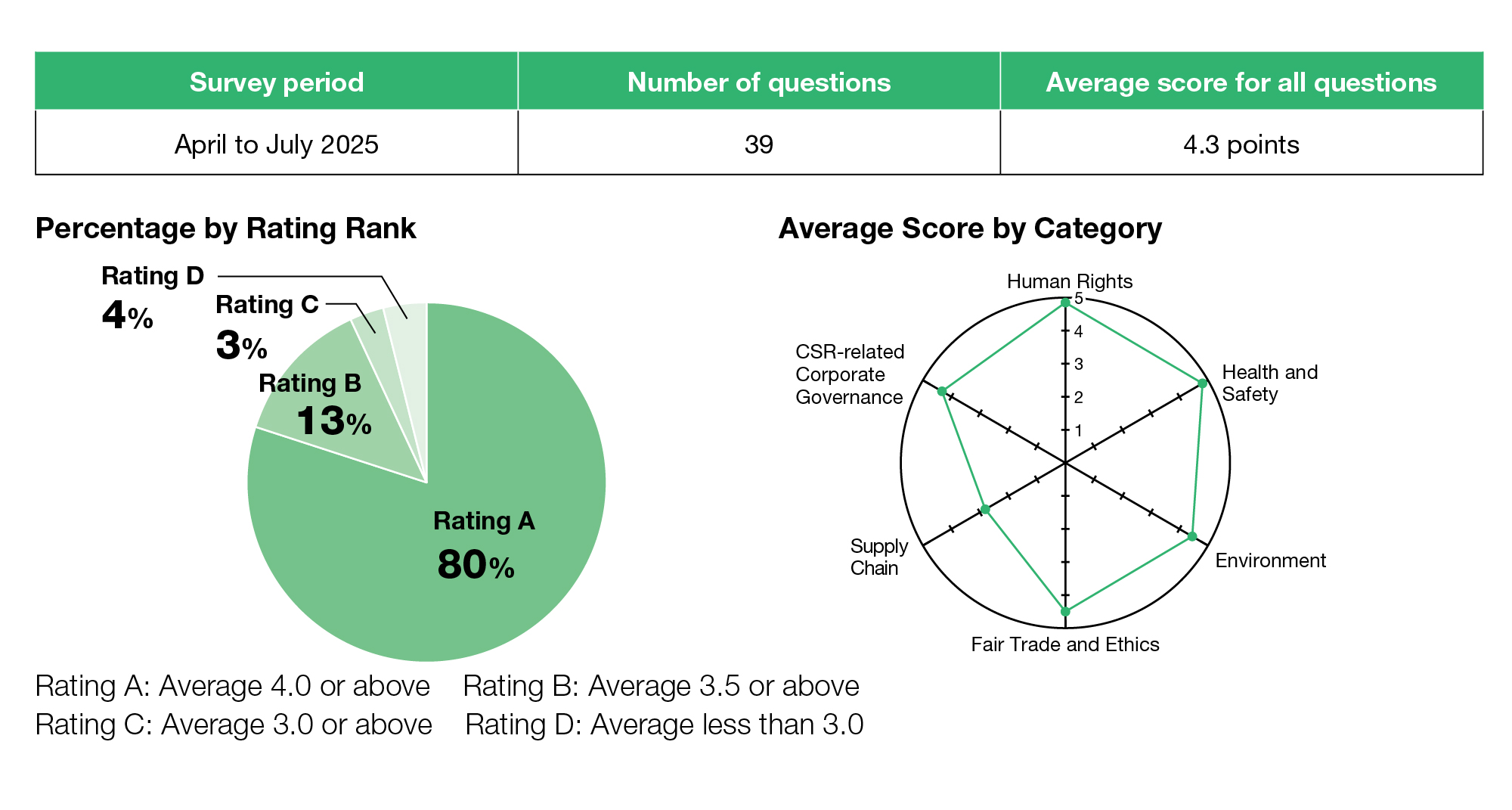
In fiscal 2025, our survey covered 105 suppliers in total, 96% of which were evaluated as having implemented initiatives satisfying the level required by the Dexerials Group (rating C or higher). As in the previous year, we conducted interviews with suppliers from which improvements were requested (rating D). During interviews, we first assess the supplier’s current situation, then explain our policies based on the CSR Procurement Guidelines, and provide reference materials prepared by the Small and Medium Enterprise Agency. We continue to work together with these suppliers on improvement initiatives while providing educational support.
CSR Procurement Survey Results (as of July 2025)
Response to Conflict Minerals
Metals produced through illegal mining by antigovernment armed groups have become a global problem, and companies are required to take a responsible procurement stance. Our products also use four metals (gold, tin, tantalum, and tungsten) that are subject to investigation under the U.S. Dodd Frank Act*, and we have received procurement requests from our suppliers.
Dexerials Group has established a Conflict Minerals Policy based on the fundamental principle of not procuring minerals that may contribute to conflicts, human rights abuses, or environmental destruction in conflict-affected and high-risk areas (CAHRAs). Through this Policy, we pursue sustainable and responsible mineral sourcing across our entire supply chain.
Among the raw materials and parts we procure, there are very few mineral-based materials compared to other raw materials. We work to responsible procurement by avoiding the use of risky raw materials and parts, based on our Group policy of “Aiming for 100% procurement from RMI Certified Smelters.”
By obtaining reliable information on the raw materials and parts we procure at the selection stage, confirming trace information on the subject minerals contained in our products, and providing appropriate information to our customers, we fulfill our responsibility as the product supplier.
- * Dodd Frank Act: U.S. Financial Regulatory Reform Act enforced in 2010 as the Wall Street Reform and Consumer Protection Act. In addition to financial regulations, as of 2013, additional provisions require manufacturers listed on the U.S. Securities and Exchange (SEC) to disclose information about their use of the four metals designated as conflict minerals.
Green Procurement
For the purposes of global environmental conservation and the realization of a sustainable society, Dexerials has established a set of Management Standards for Environment-Related Substances, and manufactures products following the Standards. The Standards define controlled substances, which are categorized as substances to be banned immediately, substances to be phased out, or exempted substances. They are also subject to monitoring in order to prevent inclusion in our products or to confirm reduction of their use.
Dexerials designates suppliers who cooperate with these standards as Dexerials Green Partners. In principle, the Dexerials Group procures all raw materials and parts used for its products from suppliers who have been qualified as such partners.
As the process to grant certification as a Green Partner, we start with explaining the “Management Standards for Environment-Related Substances” to suppliers for their understanding. Next, we individually investigate specific matters such as legal compliance to check conformity with our internal certification criteria. Each supplier meeting the certification criteria is certified and registered as a “Green Partner,” and business with such supplier starts.
Through the stable procurement based on the trust relationship with “Green Partners,” the Company will provide high-quality, reliable, and safe products to customers.
About “Management Standards for Environment-Related Substances”
Raw materials, parts, or other elements of our products that are judged by Dexerials to have a significant impact on the global environment or human health are defined as “controlled substances” and are managed accordingly.
These controlled substances are categorized as (1) substances to be banned immediately, (2) substances to be phased out, or (3) exempted substances. They are also subject to monitoring in order to prevent inclusion in our products or to confirm reduction of their use. Our aims here are to conserve the global environment and reduce our impact on the ecosystem. Even if there are no specifications in these standards with regard to certain substances and uses, we comply with the appropriate laws of each country and region in connection to prohibitions and restricted use.
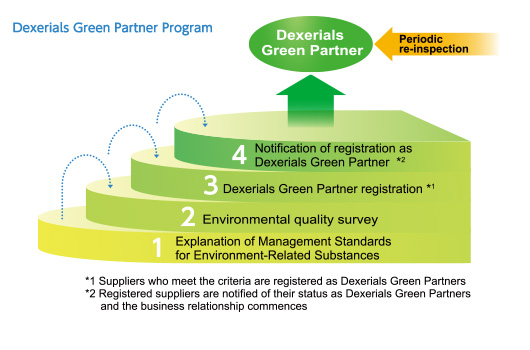
The Management Standards for the Environment-Related Substances
Supply Chain Risk Management
The globalization of procurement and logistics, and the advance of global warming, are expected to increase geopolitical risks and intensify natural disasters, making the environment surrounding the supply chain even more severe.
Therefore, reducing these risks to procurement and logistics is an important issue. We are identifying risks faced by our suppliers both within and outside Japan and building a system to prepare for and respond to various risks and disasters through digital transformation of monitoring systems and risk assessment systems.
In April 2023, we issued the “Supply Chain BCP Guidelines,” a set of disaster countermeasures that we ask our suppliers to adopt, and we are investigating whether they are taking these countermeasures in line with the Guidelines. The results of the investigation, together with the CSR Procurement Survey, will be used in the selection criteria for suppliers to achieve better supply chain stability.
Response to Procurement Issues
Procurement risks that have arisen recently include the global spread of infectious diseases, dependence on raw material suppliers, and geopolitical risks due to unstable political situations in certain regions, such as Ukraine and Taiwan. There have also been cases in which raw materials could not be secured due to natural disasters, or cases in which the use of raw materials was restricted due to the introduction or revision of laws and regulations.
In response to such risks, the Company will take measures such as increasing its procurement sources to multiple sources and increasing its stock of raw materials from normal times to ensure the stable continuation of business.