




About Our
Products
In-vehicle displays│Case study of Anti-reflection film
- Optical technology that supports the visibility and safety of in-vehicle displays
- Dexerials’ anti-reflection film contributes to the development of in-vehicle displays. It is based on our optical thin-film technology using optical interference to provide drivers with clear views that help them obtain information instantly. Compared with conventional methods, this anti-reflection film shows minimal variation in reflection across the entire visible wavelength range, providing a more uniform, superior anti-reflection performance. It suppresses reflection from in-vehicle displays under all illuminative conditions to support safe, comfortable driving.

View information about this product
Application
Improving all visibility while driving by suppressing the reflection of outside light and in-vehicle lighting
Dexerials has developed on its own the moth-eye-like structure with nanometer-sized bumps on its surface, similar to the surface of a moth's eye. The anti-reflection film with this structure significantly reduces light reflection on the display surface.
High durability and abrasion resistance that help films withstand harsh in-vehicle environments
Forming a fluorine-based antifouling layer on a film using vacuum evaporation—one of the dry production methods—provides a surface property of fingerprint/stain resistance. Moreover, its abrasion resistance is 40 times or more greater than that of our conventional film, contributing to long-term product use.
Additional function of scattering prevention
When the display surface is damaged by an impact, such as an accident, this surface film prevents glass fragments from scattering. This helps prevent injuries to the driver and passengers, thereby improving safety.
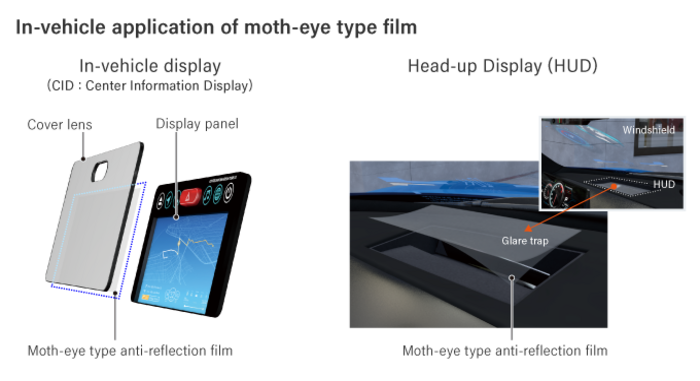
Product characteristics
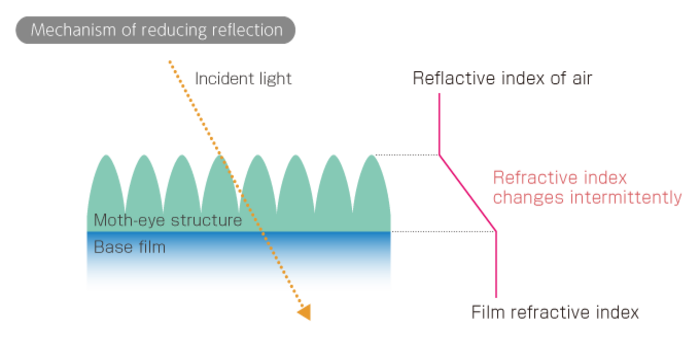
Ultra-low reflectivity technology based on moth-eye structure
Our moth-eye-type AR film reduces the light reflection to almost zero with bumps smaller than visible wavelengths (380 to 780 nm) formed on a resin film, just like the surface of a moth's eye. Moreover, forming multiple-layered thin films with different refractive indices produces light interference to suppress reflection. While the reflectivity of an ordinary PET film is approximately 10%, this moth-eye-type AR film can reduce it to 0% to 1%.
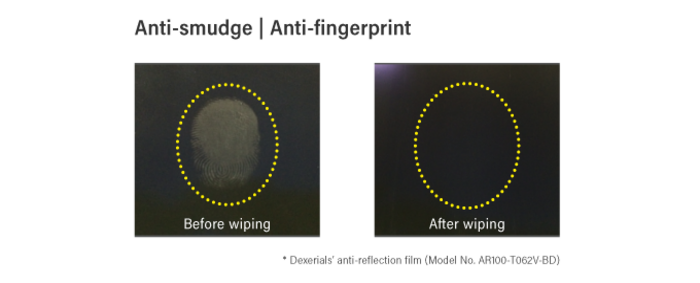
Excellent stain-resistant properties
The anti-fouling film is made of a special fluorine-based resin with excellent water repellency, so even if fingerprints or dirt get on the screen during use, they can be easily wiped off.
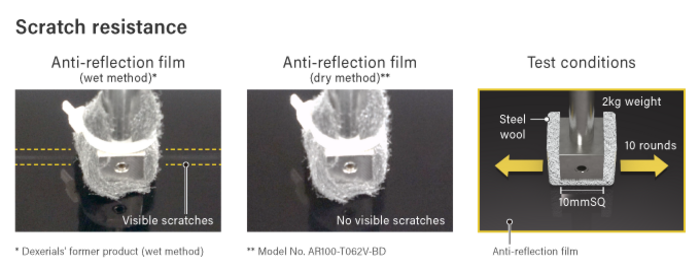
Excellent abrasion resistance
Because the anti-reflective layer consists of a robust inorganic film formed by a dry process, scratches would not occur even under harsh test conditions, such as rubbing back and forth 10 times with a force of 2 kg using steel wool, demonstrating higher abrasion resistance than products manufactured by wet processes.
Product information
Optical Semiconductor