




About Our
Products
Eye shield material for medical│Case study of Anti-reflection film
- Solution to the reflection and fogging of medical eye shields
- Dexerials’ anti-reflection film moth-eye type has the moth-eye structure that has many nanometer-sized bumps arrayed with uniform spacing, which reduces reflection of light such as illumination to a tiny level. In addition, it has an anti-fog function with a special material that spreads water vapor in exhaled breath air, providing medical professionals with clear and stable views constantly, contributing to reducing their burden and the improvement of quality in medical care.

View information about this product
Application
Reduction in surgeons’ eye fatigue by suppressing reflection of surgical lighting (shadowless lamp)
While the reflectivity of a conventional medical eye-shield film using a PET substrate is 8.4%, Dexerials’ film with the moth-eye structure uses a polycarbonate substrate to provide an extremely low reflectivity as low as 0.4%. This ultra-low reflection eliminates the reflection of surgical lighting to mitigate medical professionals’ eye fatigue.
Excellent anti-fogging property
Using an extremely hydrophilic resin to form a moth-eye structure prevents water contained in exhaled breath air from condensing to become waterdrops. Due to this effect, blowing a breath on the surface can hardly cause fogging.
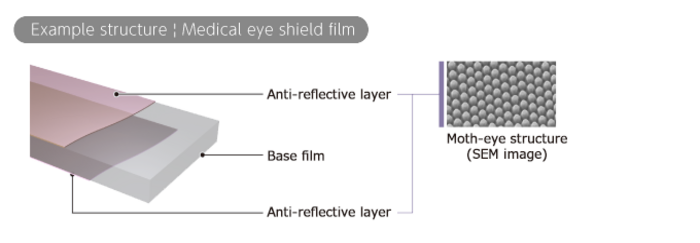
Product characteristics
Ultra-low reflectivity technology based on moth-eye structure
Dexerials has developed on its own the technology that forms a structure with nanometer-sized tiny bumps on a film surface like the surface of moths’ eyes. This designed microstructure allows light with various angles of incidence to enter the structure while continuously altering the refractive index, resulting in almost no light reflection.
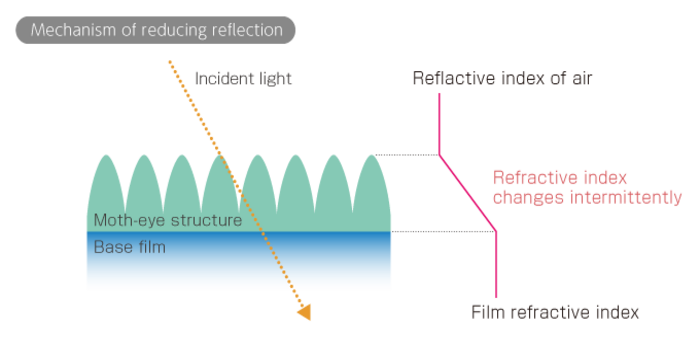
Low reflectance and excellent transparency
While the reflectivity of a conventional eye-shield film using a PET substrate is 8.4%, Dexerials uses a polycarbonate substrate to make a film with the moth-eye structure and has reduced the reflectivity to 0.4% successfully. As for transparency, while the transmissivity of a conventional eye-shield film (PET substrate) is 90.6%, our film boasts an excellent transmissivity of 99.3%.
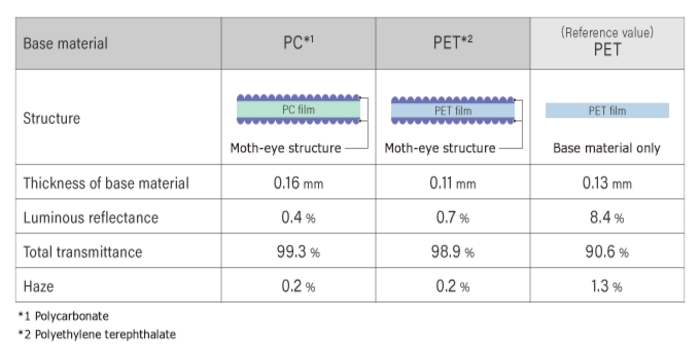
Anti-fogging function based on hydrophilic property
A highly hydrophilic resin layer formed on a shield surface spreads water vapor instantly when it adheres to the surface to prevent forming waterdrops, which prevents shield fogging.
Product information
Optical Semiconductor