



About Our
Products
Optical Transceiver | Case study of Photodiode
- Photoelectric Conversion Device That Supports the Evolution of Data Centers
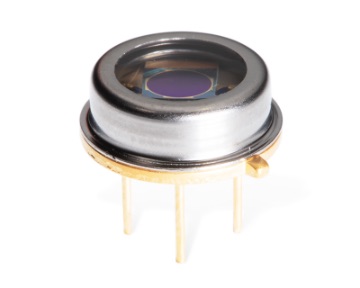
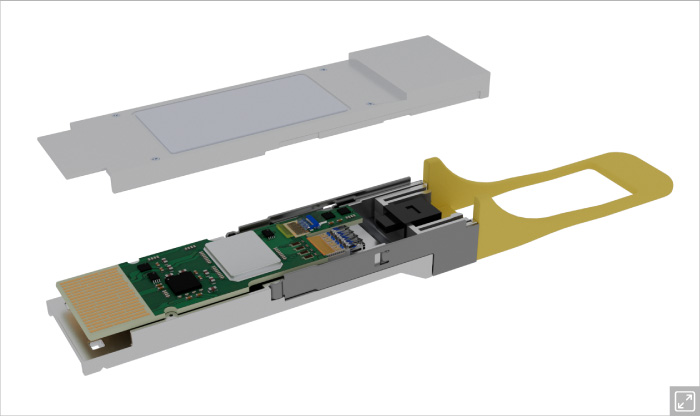
- In the context of the development of AI technology and the increase in data traffic, optical transceivers adopted in data centers have shifted from conventional 100 Gbps to 800 Gbps around 2024. Further capacity increase and acceleration to 1.6 Tbps, then 3.2 Tbps will be in demand in the future. Photodiodes from Dexerials realize the critical performance required for next-generation high-speed optical transceivers and boost the technological innovation of data centers.

View information about this product
Application
Support for ultra-high-speed optical communication
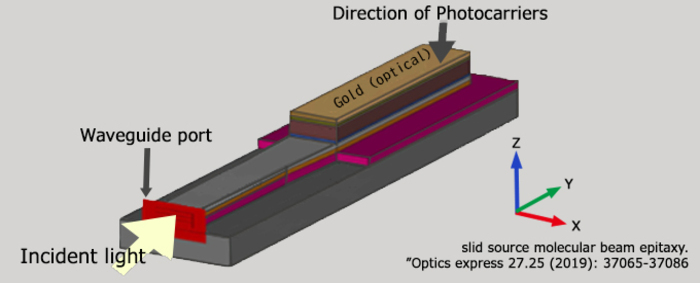
Incident light from the side of a waveguide photodiode is absorbed as it propagates through the waveguide layer of the optical semiconductor and is converted into an electric signal. This structure achieves both excellent sensitivity and high-speed signal transmission. In addition, integration with UTC-PD technology allows for ultra-high-speed operation at over 300 GHz and high current output to support next-generation optical communication.
Combination of high-speed response and miniaturization
The thin waveguide layer of waveguide photodiodes reduces the travel time for electrons or holes generated by light to reach an electrode, achieving a high-speed response. In addition, because the device can be thinner, it is easily integrated onto the same board as other optical parts, contributing to the size reduction of the system as a whole.
Product characteristics
Waveguide structure
Unlike conventional surface-incident photodiodes, in which light enters from the top, light enters the side of photodiodes with a waveguide structure and horizontally propagates along the internal light-absorbing layer. Lateral light transmission allows for longer transmission distances, which improves light absorption efficiency. At the same time, a thinner waveguide layer reduces the time for electrons or holes to reach an electrode. This structure achieves both high-speed response and high sensitivity.
Further acceleration through integration with UTC-PD technology
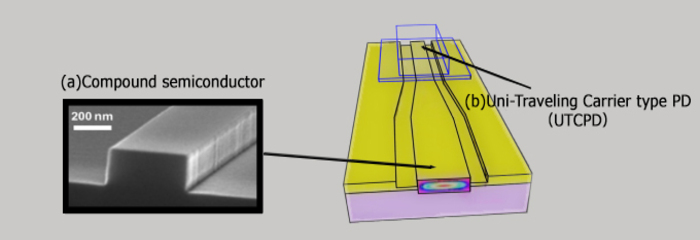
UTC-PD is a new technology that promises to further accelerate waveguide photodiodes. Usually, semiconductor holes move slower than electrons and hinder acceleration. UTC-PD solves this challenge by causing holes to flow collectively all at once using the dielectric relaxation phenomenon. In addition, a transport layer specifically for electrons prevents deceleration and output saturation due to interference with holes, achieving high-speed, high-output operation.
Product information
Optical Semiconductor