
- Home
- Sustainability
- Initiatives to Reduce Environmental Impact
Initiatives to Reduce Environmental Impact
- Environmental Philosophy and Basic Policy
- Environmental Management
- Climate Change (Disclosure Based on TCFD Framework)
- Resource Recycling
- Pollution Prevention
- Water Resource Conservation
- Chemical Substances Management
- Environmentally Friendly Products
Reducing GHG Emission Volumes: Dealing with Climate Change
Dexerials Photonics Solutions Corporation purchased carbon offsetting forest absorption credit (J-VER) for forests owned by Tome City
Dexerials Photonics Solutions Corporation, a consolidated subsidiary of Dexerials, purchased a part of the carbon offsetting credit (J-VER), i.e., the absorption volume of CO2 emissions, Tome City, Miyagi Prefecture was granted from the Ministry of the Environment by tree thinning in the city-owned forest. We purchased the credit equivalent to 100 t-CO2 with a view to offsetting our emissions in the future.
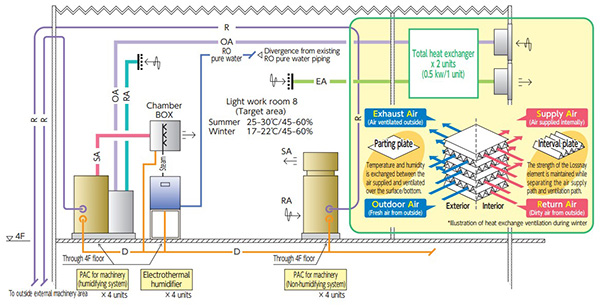
Use of total heat exchangers for air-conditioning systems (Tochigi Technology Center)
We investigated reducing energy usage in air-conditioning systems when constructing the floor of the No. 4 building at the Tochigi Technology Center. With conventional outside air exchange, heating was required by means of a heater for air temperature control in winter in particular. By introducing total heat exchangers, the temperature difference in comparison to outside air during ventilation can be eliminated and heating by means of heaters becomes unnecessary, which enables an annual reduction in energy of 200,000 kWh (97 t-CO2).
Fluorocarbon emissions reduction countermeasure (all plants)
We are carrying out activities so that fluorocarbon is not emitted, such as attaching the “machinery using fluorocarbon” management label to machinery that uses fluorocarbon, which visualizes fluorocarbon use and controls simple checks, regular inspections and disposal, etc.
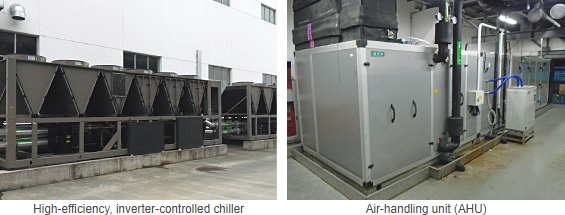
Reducing power consumption by introducing high energy-saving models (Dexerials (Suzhou) Co., Ltd.)
When establishing a new plant, Dexerials (Suzhou) Co., Ltd. introduced high-efficiency, inverter-controlled chillers and air-handling units (AHU). This introduction has resulted in energy savings of about 500,000 kWh (377 t-CO2) per year compared with existing equipment in the plant.
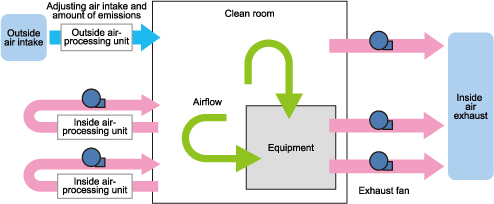
Reducing power consumption by reviewing operation of air-conditioning equipment in the clean room on days off (Kanuma Plant)
In the clean room where Anisotropic Conductive Film (ACF) is produced, air-conditioning equipment operates continuously throughout the year to maintain cleanliness in the room. To reduce power consumption, operation of the equipment on days off when the Kanuma Plant is not in operation was reviewed. As a result of the review, air intake and amount of emissions have been adjusted while operating an inside air-processing unit to maintain cleanliness in the clean room, decreasing the operating power of an outside air-processing unit that uses a lot of electricity to keep air at an appropriate temperature. This has resulted in energy savings of 1.08 million kWh (408 t-CO2 reduction) per year.
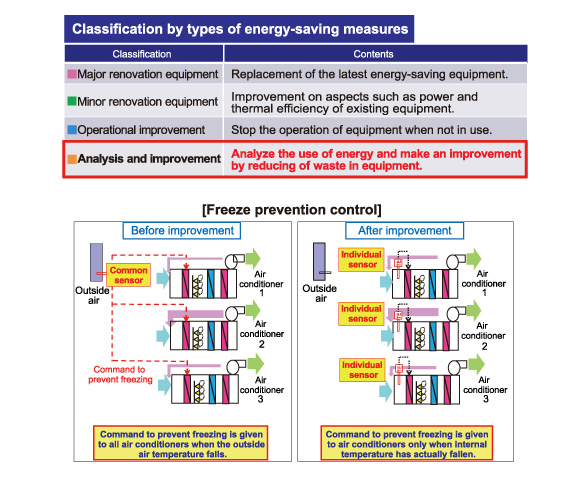
Reducing power consumption and gas emissions of air conditioners through an energy-saving measure based on analysis and improvement (Kanuma Plant)
A new energy-saving measure based on “analysis and improvement” was used. Under this measure, the use of energy is analyzed and waste is cut. By using this measure to re-examine the system of freeze prevention control for air conditioners, energy was reduced by 60,000 kWh (electricity) (23t-CO2) and by 43,000 m3 (gas) (91t-CO2) in a year.
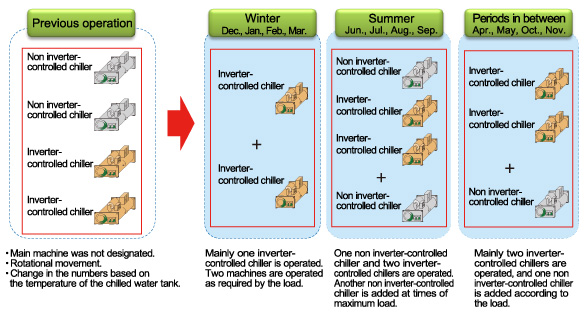
Reducing power consumption by prioritizing the operation of chillers with high energy-saving effect (Kanuma Plant)
Previously, two inverter-controlled chillers and two constant-speed chillers were operated in accordance with the load. However, reduction of 590,000 kWh (223t-CO2) was achieved in a year by prioritizing the operation of inverter-controlled chillers with high energy-saving effect.
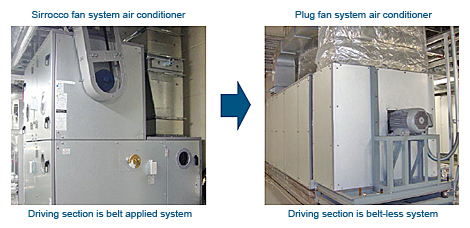
Reducing power by using plug fan air conditioners (Kanuma Plant)
Air conditioners consume a vast amount of energy, so they are a key focus of energy conservation measures. Switching from conventional belt-driven sirocco fans to plug fans, which do not use a fan belt and reduce belt transmission loss by being directly coupled to the fan shaft, led to 31,000 kWh per fan of energy being conserved annually, in terms of air-conditioning power.
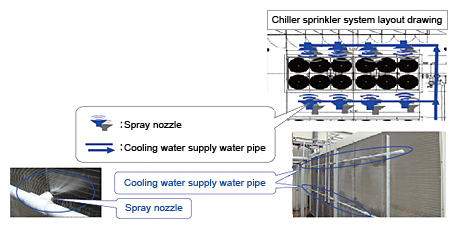
Reducing power by spraying water on air-cooled chillers (Kanuma Plant)
Condensing pressure has been reduced and the efficiency of energy consumption during cooling substantially increased by spraying water onto the air heat exchangers (condensers), in order to improve the cooling capabilities of air-cooled heat pumps. Repeated tests of nozzle angle, number, and spray volume were carried out when installing the spray nozzles, with a view to improving COP* leading to 23,000 kWh of energy being conserved annually.
* COP = Coefficient of performance
A coefficient used as a guide to the energy consumption efficiency of cooling equipment. The figure expresses cooling/heating capabilities per kW of electricity consumed.
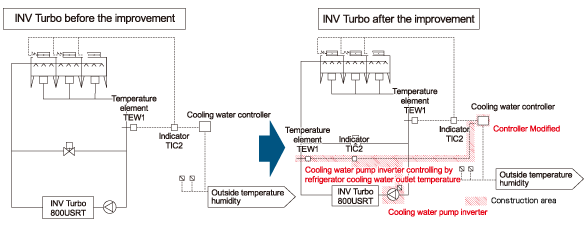
Reducing the drive power of cooling water pumps used in refrigerating machines (Kanuma Plant)
The cooling water pumps used in turbo refrigerating machines operate using a certain volume of cooling water, regardless of outside air temperature or humidity, so they were particularly inefficient during intermediate seasons and winter, when there was little air-conditioning load. Controlling the volume of cooling water and automatically setting the optimum cooling water temperature (summer / intermediate seasons / winter) using an inverter (INV) that responds to the constantly changing wet-bulb temperature has led to the conservation of 170,000 kWh of energy annually.
Reduction of Water Usage
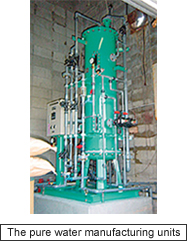
Reducing the volume of pure water used (Dexerials Photonics Solutions Corporation)
We optimized the flow rate of the pure water production system used in manufacturing cleaning processes and achieved an approximately 16% reduction in pure water consumption.
We also consolidated supply line systems to further increase the reduction in pure water consumption.
In addition, we introduced several process improvements that contribute to reducing pure water use. One measure involved reducing the frequency of water replacement by switching from a centralized management tank to individually managed tanks for processes with higher levels of contamination. Another measure involved shortening operating hours by optimizing the flow rate of cleaning equipment.
Reduction of Industrial Waste
Reuse
Introduction of reusable shipping cartons (Dexerials (Suzhou) Co., Ltd.)
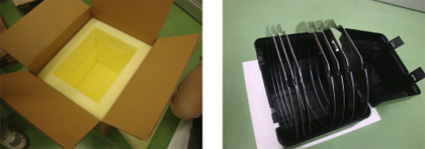
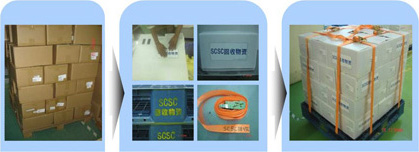
Dexerials (Suzhou) has changed over from the cardboard boxes previously used to plastic shipping boxes that can be used for 12 months. A single model enables reduction of 10 tons of waste a year. Moreover, the previous vinyl wrapping has been changed to special securing bands, resulting in a reduction in the amount of vinyl wrapping used.
Reducing packing materials through the introduction of returnable containers (all plants in Japan)
At all plants in Japan, products for Japanese domestic distribution were loaded onto palettes and had their corner and wrapping materials further reinforced before being shipped. However, although these packing materials were either completely recycled (valuable materials) or disposed of as industrial waste after being shipped, these represented wasteful parts with no added value from the perspective of the product. Therefore, in October 2008 we established a shipping system using returnable containers, thereby achieving a substantial reduction in our packing materials.
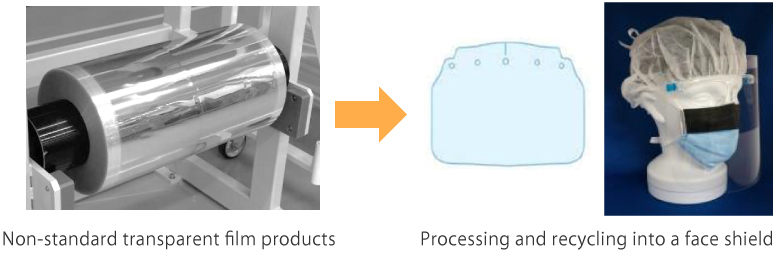
Processing and recycling non-standard products for different applications (Kanuma Plant)
Recycling
Dexerials took a stake in R Plus Japan, Ltd.
Dexerials took a stake in R Plus Japan, Ltd. in support of its corporate spirit. R Plus Japan operates a business to recycle used plastics. Going forward, we will contribute to reducing environmental burden and realizing a sustainable society through resources recycling using R Plus Japan’s chemical recycling technique.

Effective use of resources through RPF recycling (converting waste to solid fuel) (all plants in Japan and Dexerials (Suzhou) Co., Ltd.)
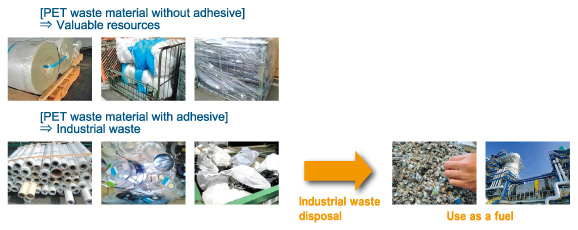
At all plants in Japan, as well as at Dexerials (Suzhou) Co., Ltd., plastic film offcuts from production processes have always been treated as valuable resources. Those that have other materials (mainly adhesives) stuck to them as a result of the production process, which cannot be treated as valuable resources, are disposed of as industrial waste and used effectively as a resource through RPF* recycling.
- *RPF (Refuse Paper & Plastic Fuel): Solid fuel of a high calorie which is made from used paper and a plastic with difficult material recycle as materials with industrial system waste.
Promoting recycling month (Dexerials Photonics Solutions Corporation)
Promoting October 20 as Recycling Day
The "Sort burnable waste. Increase recyclable waste," campaign was implemented.
Reduction
Reducing organic solvents in the manufacturing process of liquid adhesives (Kanuma Plant)
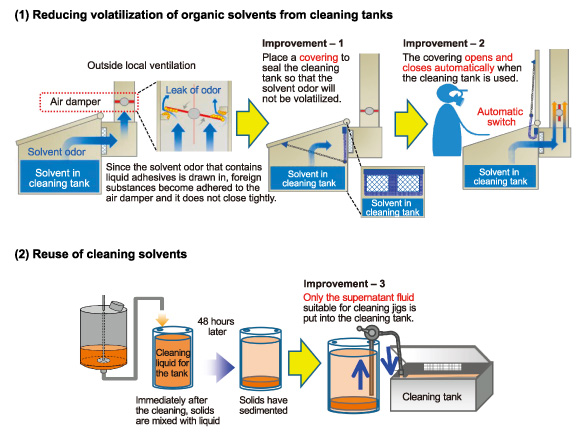
Kanuma Plant deals with a large amount of organic solvents. It is working on improvements focusing not only on the reduction of their use, but also on the reduction of their emissions.
Measures taken to reduce environmental load by reducing organic solvents included: (1) reducing volatilization of organic solvents from cleaning tanks; and (2) reuse of cleaning solvents. As a result, the use of organic solvents was reduced by 16.5 tons per year, and waste disposal was reduced by 5.8 tons per year.
Activities to reduce food waste (all plants in Japan)
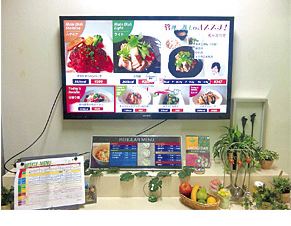
The Dexerials Group is promoting activities aimed at reducing food waste (leftovers) from its staff canteens. Ongoing activities are being undertaken in partnership with canteen contractors, with measures including the use of displays of sample menus, confirming the number of employees in order to prevent too many meals being made, and thorough draining of leftovers.